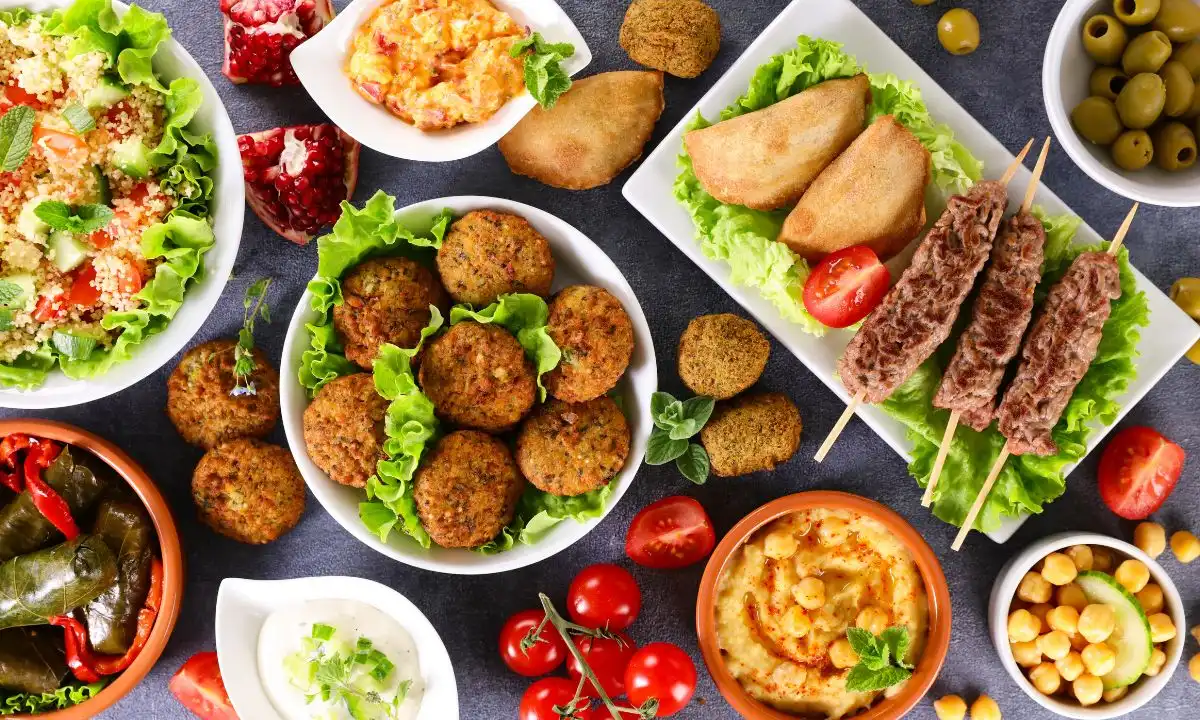
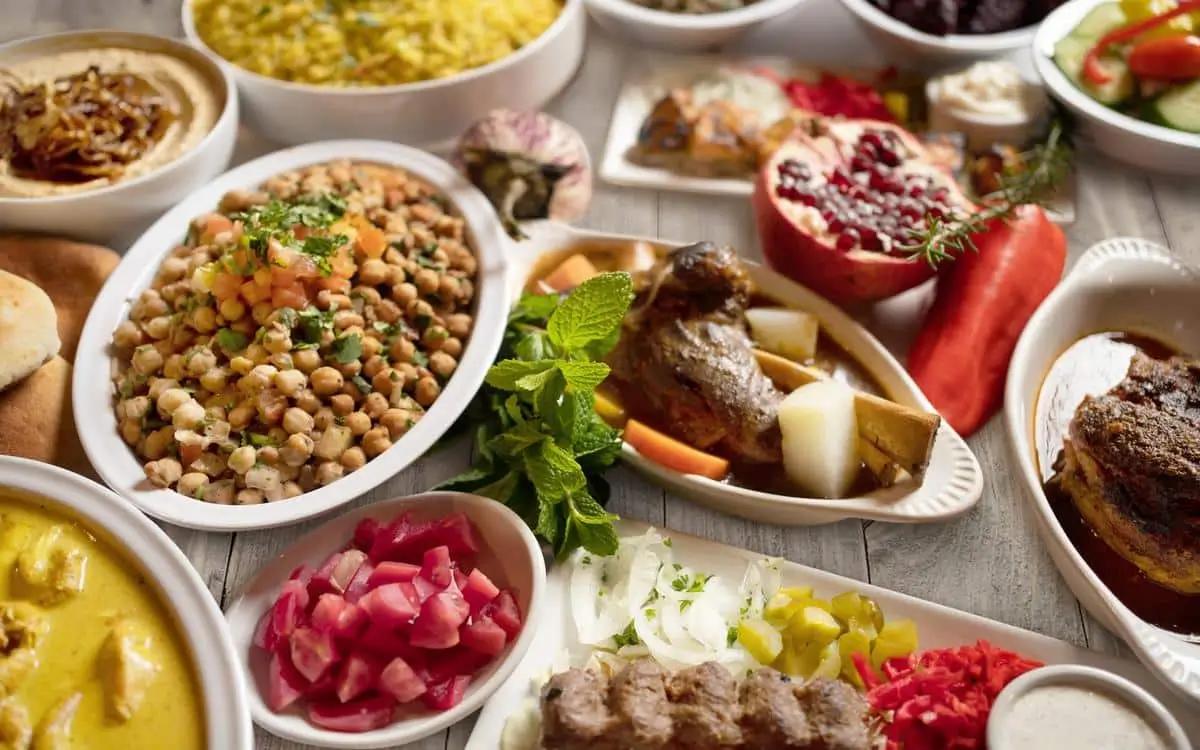
Mediterranean food is the cuisine of countries that border the Mediterranean Sea — Lebanon, Greece, Turkey, Israel, Syria, and beyond — built around olive oil, fresh vegetables, grains, legumes, yogurt, and grilled meats. It’s widely considered one of the healthiest cuisines on earth, and in cities like Houston it’s become one of the most beloved.
At Aladdin Mediterranean cuisine, we’ve been serving halal Lebanese and Greek dishes from our Montrose kitchen since 2006. In this guide, we’re walking through the 12 Mediterranean dishes we think every Houstonian should try at least once — why they matter, what’s in them, and where to taste the real thing.
Quick answer: The most iconic Mediterranean foods include hummus, falafel, shawarma, kabobs, tabbouleh, baba ganoush, moussaka, lahmajoun, pilaf, grape leaves, baklava, and muhammara. Most are vegetarian-friendly, halal-compatible, and feature olive oil, fresh herbs, and grilled or baked preparation.
Mediterranean cuisine isn’t one national cuisine — it’s the shared cooking tradition of more than 20 countries that ring the Mediterranean Sea, from Spain and Morocco in the west to Turkey, Lebanon, and Israel in the east, with Greece, Italy, and Egypt in between.
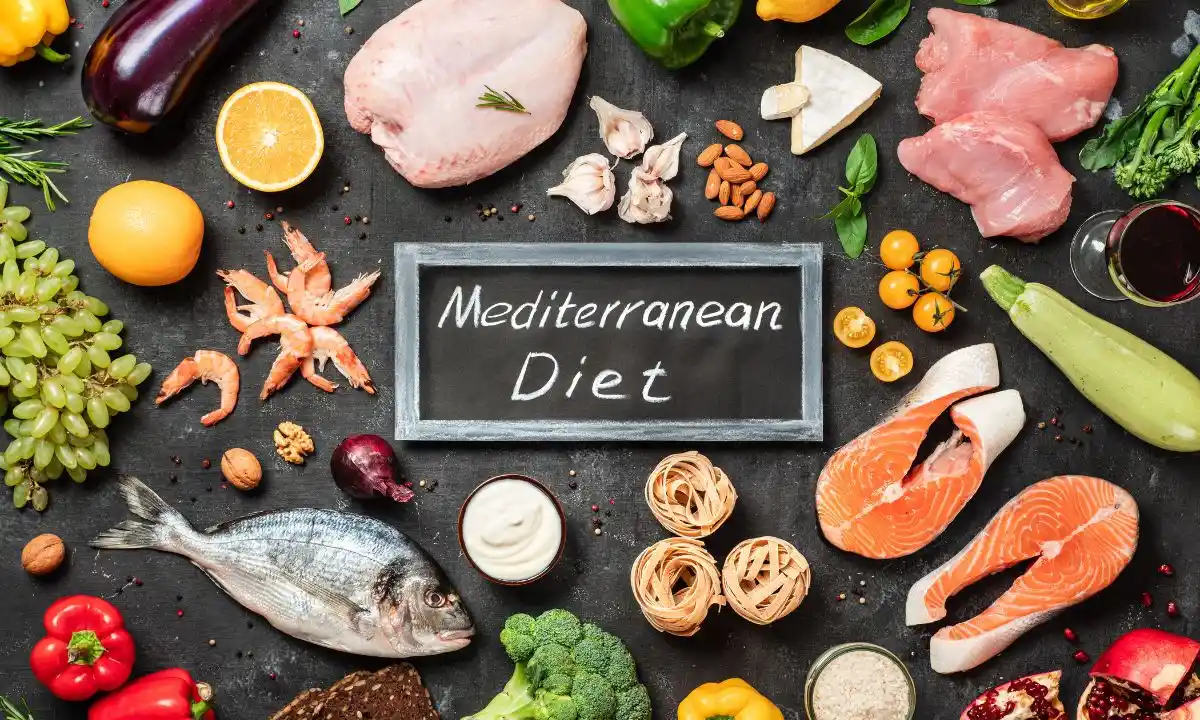
What links them together is a small set of ingredients used over and over in different combinations: olive oil, fresh vegetables and herbs, whole grains, legumes (chickpeas, lentils, fava beans), yogurt and fresh cheese, seafood, and grilled or slow-cooked meats. Red meat shows up sparingly. Processed foods and deep-frying are rare. Plates are meant to be shared.
The traditional Mediterranean diet has been linked to lower rates of heart disease, diabetes, and early mortality in decades of nutrition research — it consistently tops “best diet” rankings from U.S. News, Harvard, and the Mayo Clinic.
At a Mediterranean restaurant, you’ll usually find the same patterns playing out on the menu: dips and spreads scooped up with warm bread, grilled meats served with rice or salad, long-simmered stews, and a dessert that leans on honey and nuts rather than sugar and butter. Every dish below is a version of that pattern.
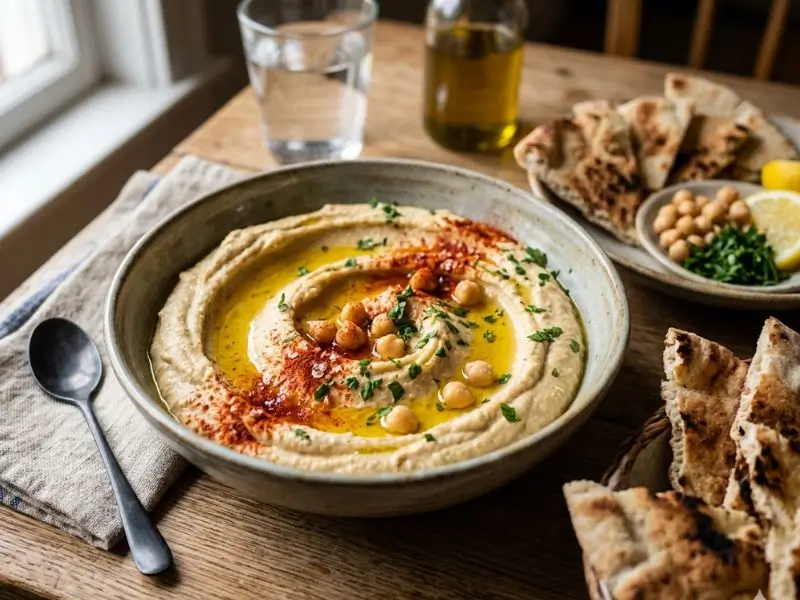
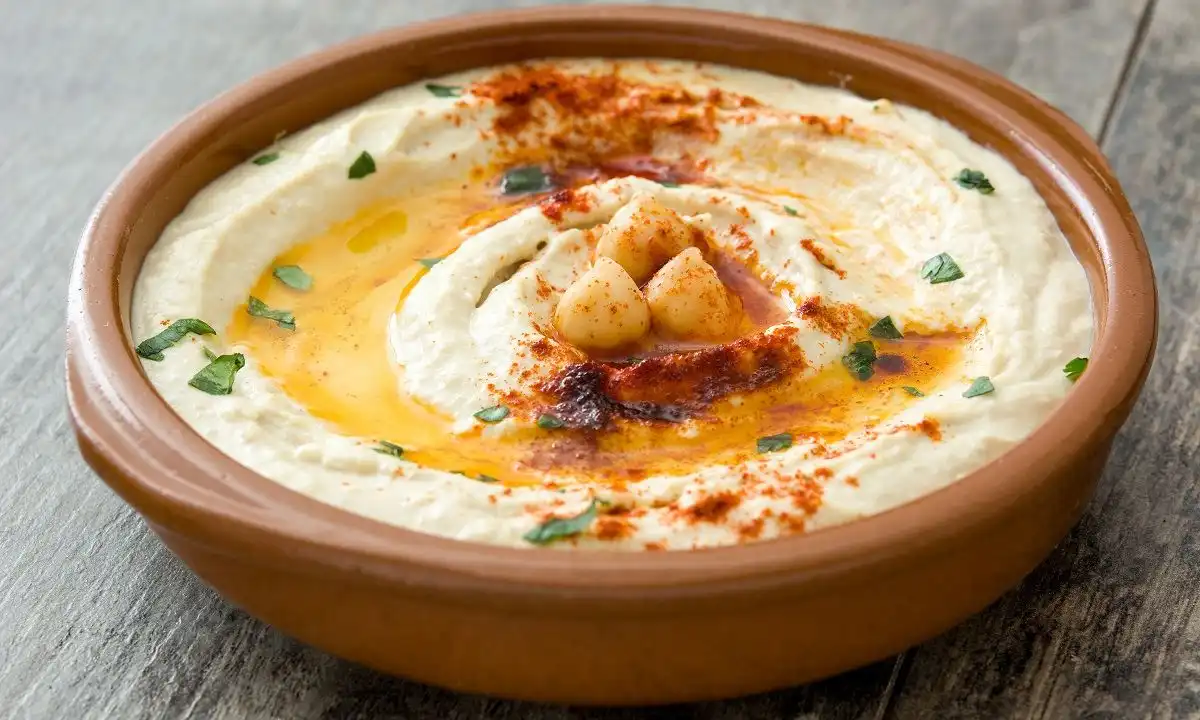
If you can name one Mediterranean food from memory, it’s probably hummus. The dish is simple — cooked chickpeas blended smooth with tahini (sesame paste), lemon juice, garlic, and olive oil — but done right, it’s genuinely addictive.
Hummus is the most widely adopted Mediterranean dish worldwide. It’s vegan, gluten-free, naturally high in protein and fiber, and it plays well with almost everything: warm pita, fresh vegetables, kabobs, falafel, or a spoon.
What separates great hummus from mediocre hummus is the tahini. Cheap tahini makes chalky, flat-tasting hummus. Good tahini — cold-pressed from well-sourced sesame seeds — makes hummus taste creamy, nutty, and alive.
At Aladdin, we make ours fresh every morning and serve it traditional-style (with a pool of olive oil in the middle), topped with spiced beef for a heartier version, or blended with roasted red pepper, caramelized onion, or jalapeño for our rotating specials. Learn more about what hummus actually is →
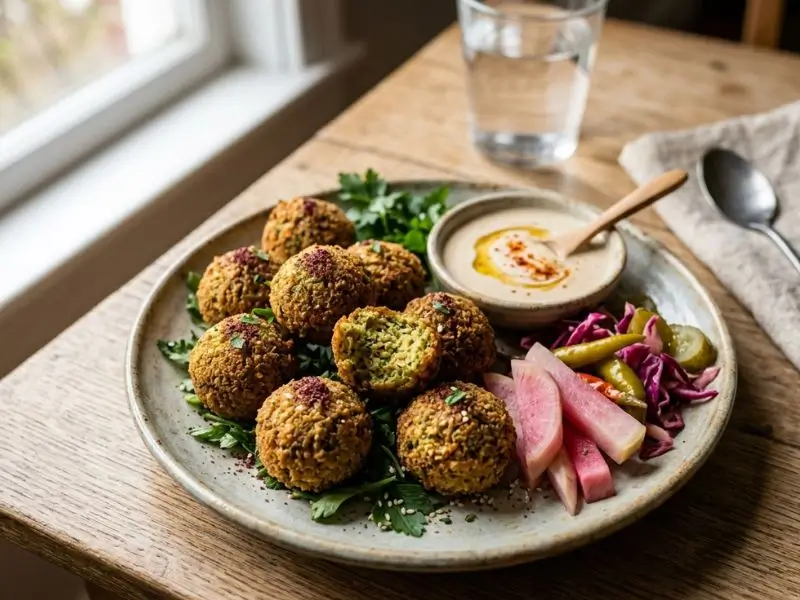
Falafel is a deep-fried ball or patty made from ground chickpeas (or fava beans, depending on the country), mixed with onion, garlic, parsley, cilantro, cumin, and coriander. The outside is crackly golden; the inside is bright green and fluffy.
It’s one of the oldest plant-based protein sources still eaten today — likely originating in Egypt thousands of years ago and traveling through the Levant, eventually becoming one of Israel’s national dishes too. You’ll find variations in Lebanon, Syria, Palestine, and Egypt, each with a slightly different herb blend.
Why is falafel so beloved? Because it’s crispy, filling, and happens to be vegan, nut-free, and dairy-free without trying. For anyone eating around dietary restrictions at a Mediterranean restaurant, falafel is often the safest and most satisfying pick.
It’s usually served one of three ways: as a sandwich (in pita with lettuce, tomato, pickles, and tahini), on a plate (with rice and hummus), or tossed into a salad. Want to know if it’s actually as healthy as people say? We broke down the nutrition here → And if you want to understand where falafel comes from and why it’s everywhere, we’ve got a full explainer →.
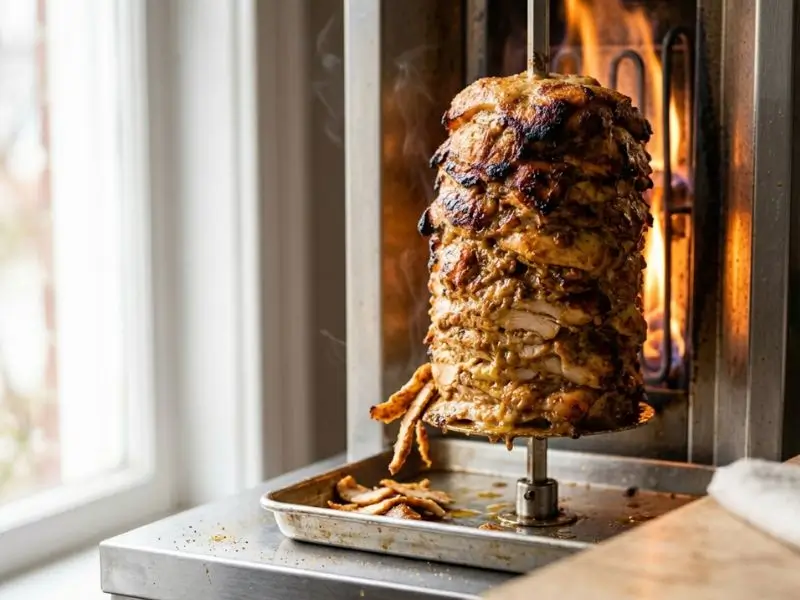
Shawarma is marinated meat — chicken, lamb, beef, or a mix — stacked on a vertical rotisserie and slow-roasted for hours. As it cooks, the outside chars and crisps; thin slices are shaved off and wrapped in pita or served on a plate.
The name comes from the Turkish word for “turning,” and the cooking method is a close cousin of the Turkish döner and the Greek gyro. What makes shawarma distinctly Levantine is the marinade: a mix of garlic, cumin, cardamom, cinnamon, and yogurt that penetrates the meat overnight.
A traditional shawarma wrap is rolled with garlic sauce (toum), pickled vegetables, and sometimes fries. A shawarma plate skips the wrap and serves the meat over rice or salad with hummus on the side.
At Aladdin, we grill chicken and lamb shawarma daily. The chicken is marinated 24 hours ahead; the lamb comes on bone-in rotisseries. If you’ve never had proper shawarma, this is a great first dish to order — it’s the most approachable Mediterranean meat dish for a Western palate.
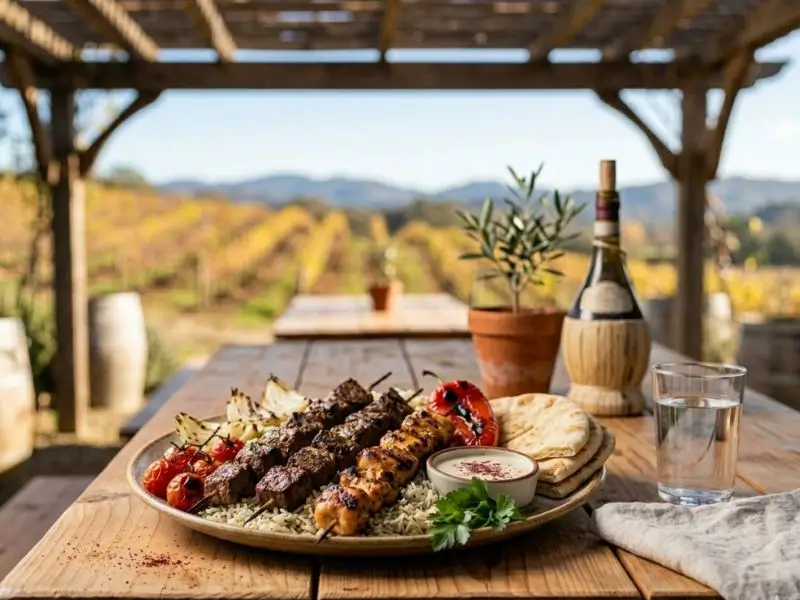
Kabob (also spelled kebab) is a broad family of skewered, grilled meats that traces back thousands of years across the Middle East and Mediterranean. The word itself simply means “grilled meat on a stick” in Arabic and Persian.
Different regions have different traditions. Lebanese kabobs tend to feature chunks of marinated meat — chicken breast, lamb, beef tenderloin — grilled over charcoal. Turkish-style adobana uses ground meat seasoned with spices and pressed onto wide skewers. Greek souvlaki uses smaller cubes of pork or chicken.
What all good kabobs share is flame, fat, and time. The meat needs to be marinated (usually in olive oil, lemon juice, garlic, and spices), grilled over live fire, and rested before serving. Our filet beef kabob → is the best argument we can make for what kabob should taste like.
At Aladdin, we serve chicken kabob (halal chicken breast, lemon-garlic marinade), beef filet kabob (halal tenderloin, minimally seasoned to let the meat speak), chipotle chicken kebab (Turkish-spiced, smoky-hot), and a mixed grill that combines all three.
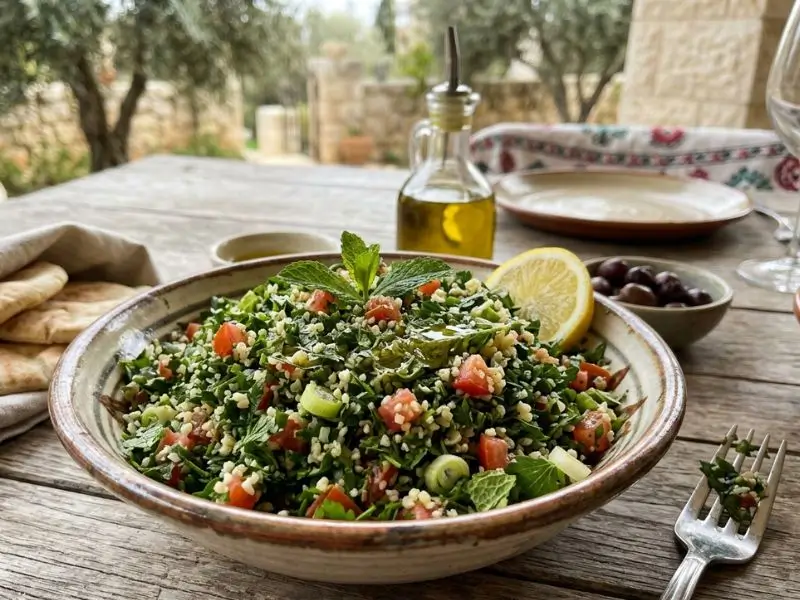
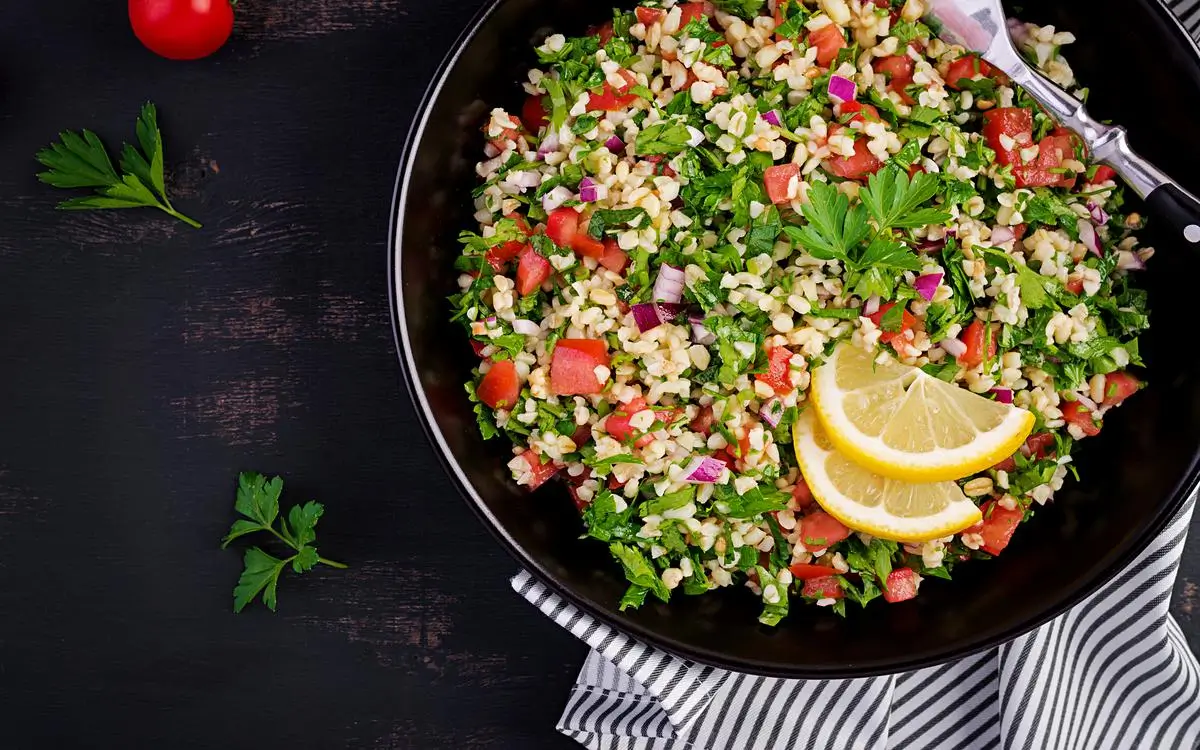
Tabbouleh is a Lebanese salad made primarily of finely chopped fresh parsley, with diced tomato, red onion, mint, and bulgur wheat, dressed simply with olive oil, lemon juice, and salt. It’s not a side dish in Lebanon — it’s the star.
The most common misconception about tabbouleh in America is that it’s a bulgur salad. Traditional Lebanese tabbouleh is a parsley salad with a little bulgur for texture — usually 80% parsley by volume, not 80% bulgur. American versions often flip that ratio and lose what makes the dish special.
Tabbouleh is vegan and vegetarian, fresh and bright, and it pairs with almost anything — kabobs, hummus, falafel, grilled fish. It’s also one of the most nutritious salads on any menu: parsley is packed with vitamins K, C, and A, and the lemon-olive oil dressing is a fat that helps absorb them.
(Quick note on spelling: you’ll see it as tabbouleh, tabouli, or tabouleh — they’re all the same dish. The Arabic original has no single correct English transliteration.) More on tabbouleh’s ingredients, history, and whether it’s healthy → and the full explainer →.
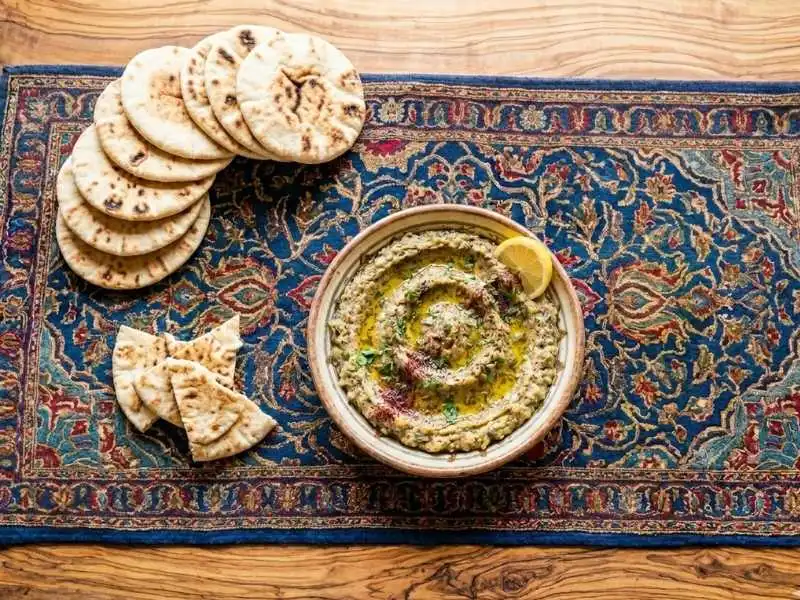
Baba ganoush (pronounced BAH-bah gah-NOOSH) is Lebanese smoked eggplant dip — whole eggplants charred over open flame until the skin blisters and the flesh inside turns silky, then blended with tahini, lemon, garlic, and olive oil.
The smoke is the whole point. A baba ganoush made without fire tastes like a beige puree; done right, it tastes like a campfire and a garden had a baby. It’s one of the more dramatic flavor transformations you’ll encounter in Mediterranean cooking.
Like hummus, baba ganoush is vegan and gluten-free. Unlike hummus, it’s lower in protein but richer in fiber and antioxidants thanks to the eggplant.
How do you know if you’re getting real baba ghanoush? Look for visible flecks of char, a slight grey tint, and a smoky aroma you can pick up from across the table. Tahini-heavy versions with no smoke are sometimes sold as “baba ghanoush” — they’re not wrong, just not the real thing. We go deep on baba ghanoush here →
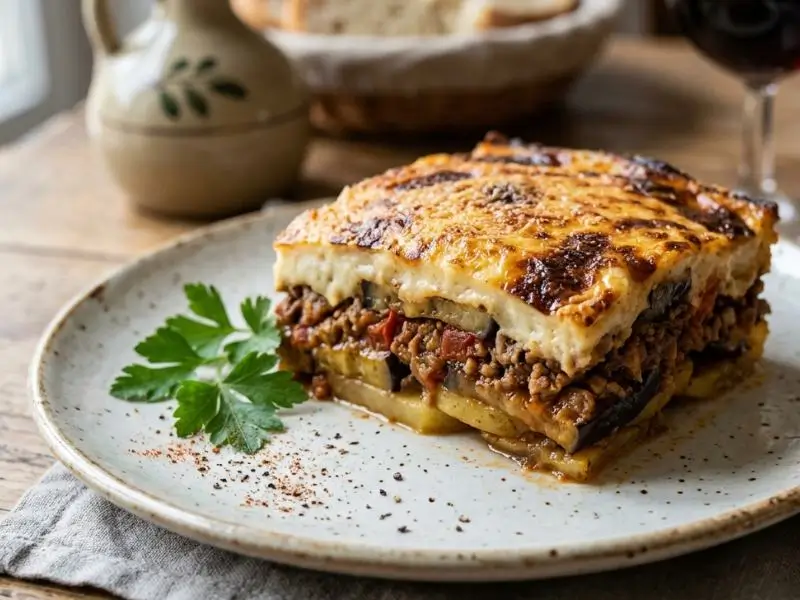
Moussaka is a baked Greek and Levantine casserole that layers roasted eggplant, potato, spiced ground lamb or beef, and béchamel sauce (a creamy white sauce made from milk, butter, and flour). It’s then baked until the top is golden-brown and slightly crisp.
If you grew up with American lasagna, moussaka will feel familiar — layered, hearty, oven-baked — but the flavor is totally different. Instead of tomato and mozzarella, the savory layer is warm with cinnamon, allspice, and nutmeg, and the top is creamy custard rather than stringy cheese.
What makes moussaka stand out is its balance. The sweetness of the roasted vegetables, the warmth of the spices, and the richness of the béchamel come together into a deeply satisfying experience. It’s comfort food with Mediterranean bones — heavy enough to be a main course but still rooted in the region’s vegetable-forward cooking.
It’s a slower dish to prepare, which is why you’ll rarely see it on quick-service menus. When a Mediterranean restaurant makes moussaka from scratch, order it.
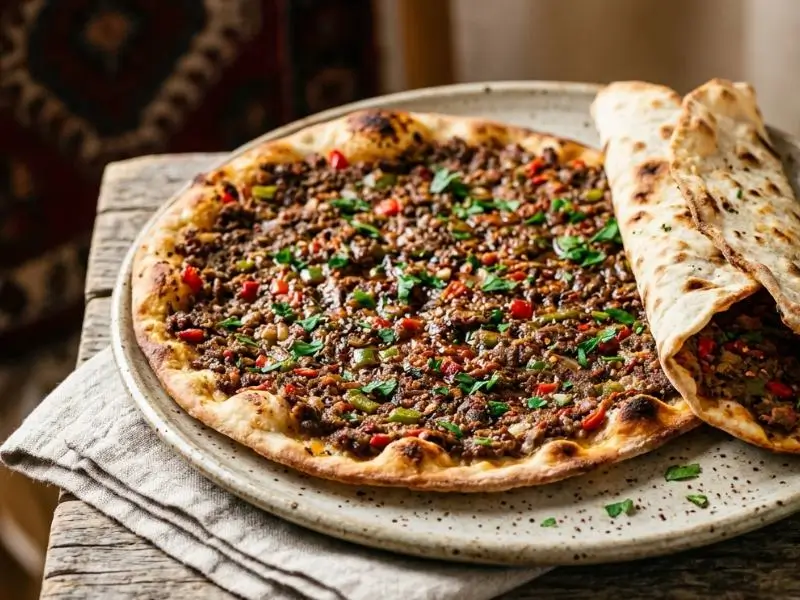
Lahmajoun (also spelled lahmacun or lahmajun) is often called “Mediterranean pizza,” but the comparison undersells it. It’s a thin, crackly flatbread topped with a savory mix of ground beef or lamb, onion, tomato, bell pepper, garlic, and warm spices — cumin, paprika, sometimes a hint of cinnamon.
It originates from the Armenian, Turkish, and Levantine kitchen traditions and is street food in much of the region. You eat it the way you’d eat a soft taco: roll it up with a squeeze of lemon and a few fresh herbs, and take big bites.
Unlike pizza, there’s no cheese. Unlike shawarma, there’s no grilled meat. Lahmajoun is its own thing — a fast-cooked flatbread with a paste-like meat topping that’s been pressed thin so everything cooks in under ten minutes.
At Aladdin, we roll the dough fresh, use halal-certified ground beef, and bake to order.
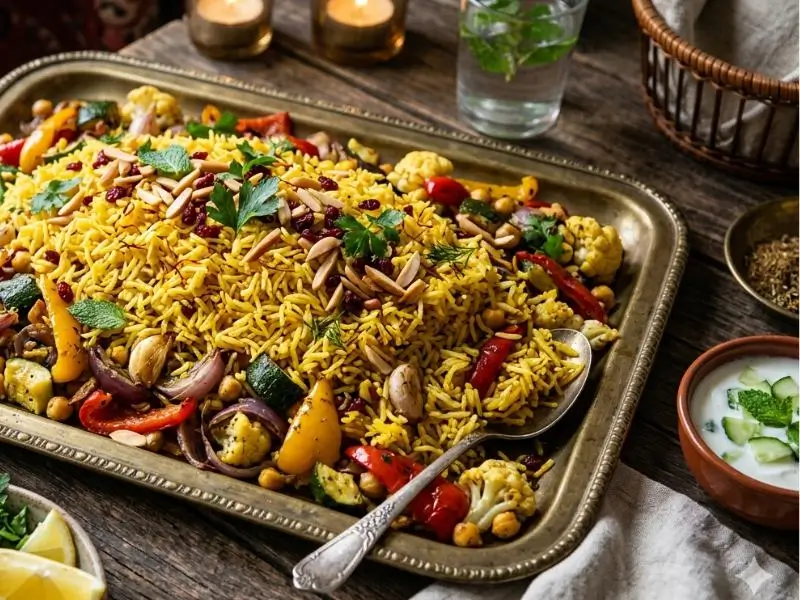
Pilaf (or pilau, pulao, polow, depending on where you are) is a rice-cooking technique, not a single dish. The rice is first toasted in fat — butter, olive oil, or rendered lamb — and then simmered in seasoned broth until every grain is separate and infused with flavor.
Done right, pilaf is a cornerstone of a Mediterranean plate. Done wrong, it’s just white rice. The difference is time and attention: toasting the rice, using the right rice-to-liquid ratio, resting it covered before serving.
Common Mediterranean pilaf variations include vermicelli rice (rice tossed with toasted pasta threads for a nutty crunch), saffron rice (yellow rice infused with saffron and diced vegetables), and rice with ground meat and nuts (a heartier version served on holidays). Each is a building block dish — something you put a kabob or stew on top of.
At Aladdin, our pilaf is made with long-grain rice, sautéed onion, cardamom, and chicken stock. It’s the base for most of our plates.
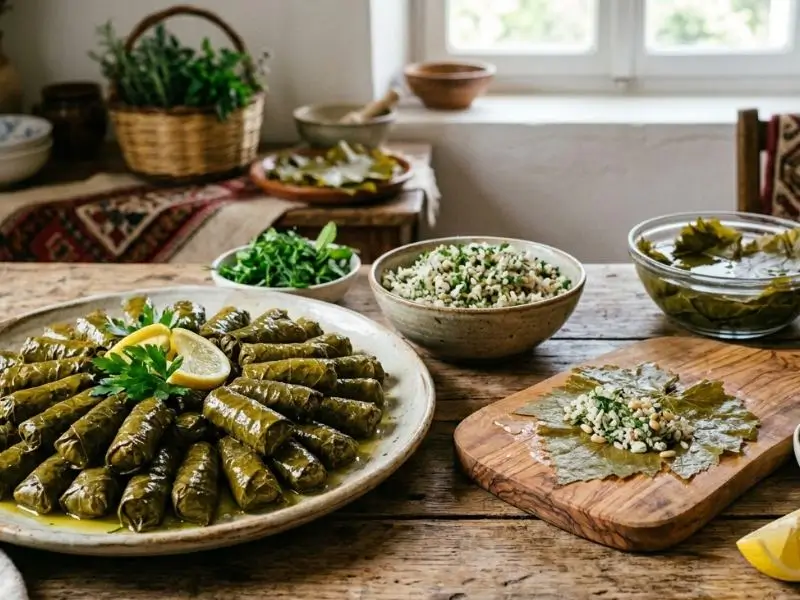
Stuffed grape leaves (called dolma or warak enab) are exactly what they sound like: grape leaves rolled around a filling of rice, herbs, and sometimes spiced meat, simmered in lemon broth, and served warm or chilled.
They’re fiddly to make — each roll is hand-wrapped and the filling ratio has to be just right — but the result is one of the most elegant small bites in Mediterranean cooking. The tartness of the leaf, the fresh herbs and rice inside, and a final squeeze of lemon on top — there’s a reason Lebanese grandmothers are famously protective of their recipes.
Vegetarian grape leaves (with just rice, onion, herbs, and olive oil) are usually served chilled as part of a mezze spread. Meat versions are served warm as a main course. Both are halal-compatible and gluten-free.
More about grape leaves and how they’re made →
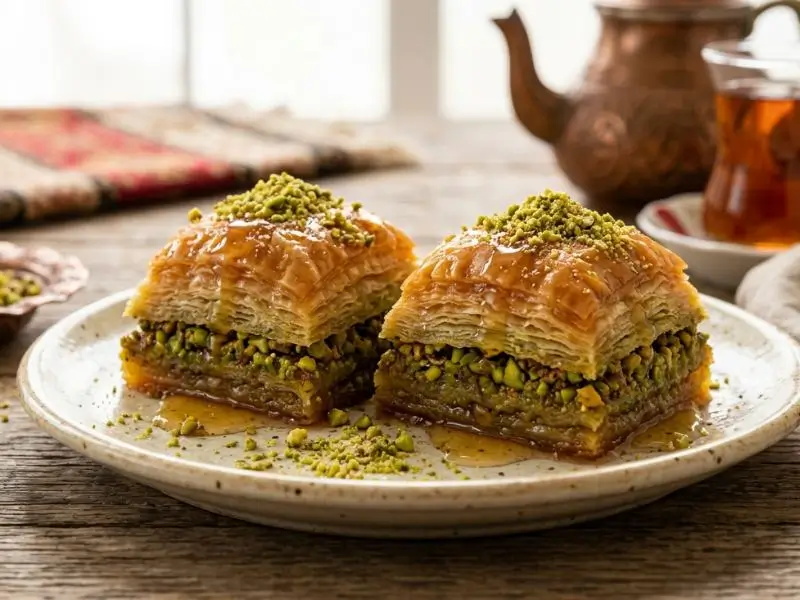
Baklava is the most iconic Mediterranean dessert — dozens of thin phyllo dough sheets layered with butter and finely chopped nuts (typically pistachio, walnut, or a mix), baked until golden, then drenched in honey-lemon or rose-water syrup while still hot.
Every major culture in the eastern Mediterranean claims some version. Turks say Turkish, Greeks say Greek, Lebanese say Lebanese, Armenians say Armenian. They’re all right — baklava is the Empire-era dessert that traveled across the whole region and picked up local variations as it went.
What makes baklava different from a typical Western dessert is its density and sweetness. It’s rich, nutty, and floral all at once. One small piece is often enough.
Is baklava “healthy”? Compared to a slice of chocolate cake, it’s lighter on refined sugar and higher in protein and healthy fats from the nuts. Compared to fruit, it’s still a dessert. We did the full nutritional breakdown here →
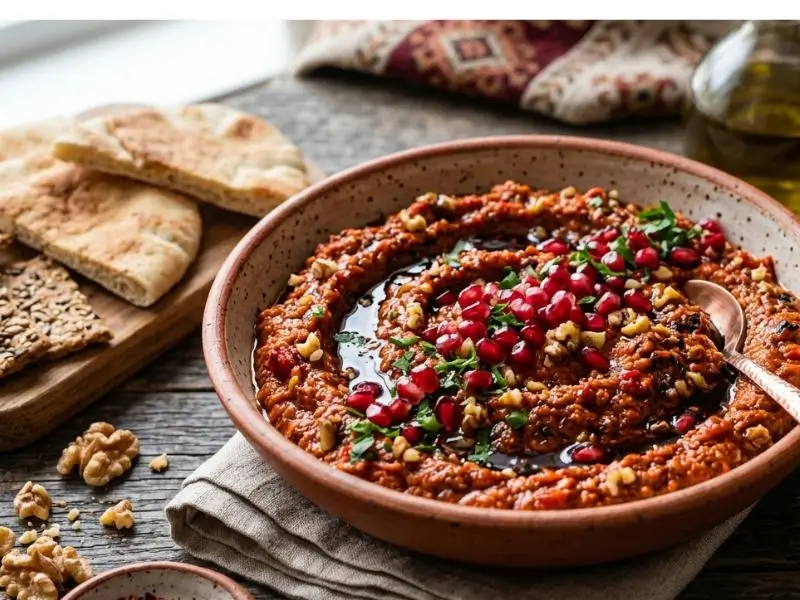
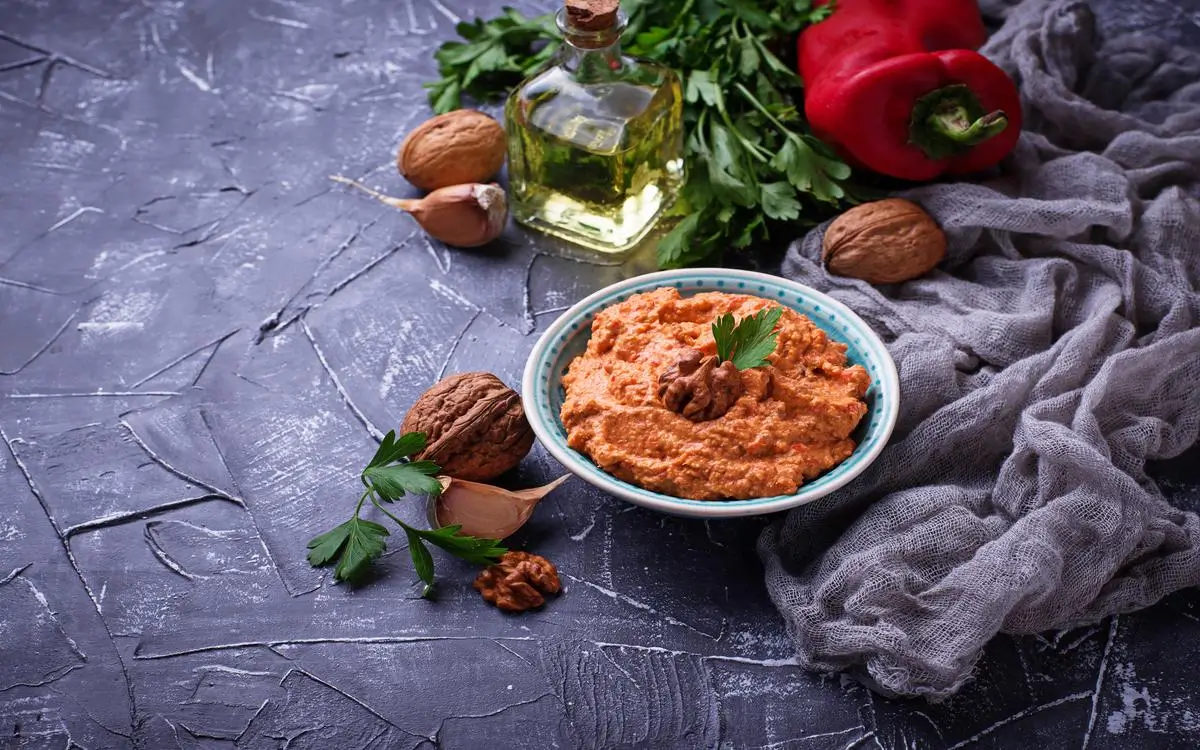
Muhammara is the dip most Americans haven’t heard of but can’t forget once they try. Roasted red peppers, walnuts, breadcrumbs, olive oil, lemon, and — the signature ingredient — pomegranate molasses, all blended into a slightly chunky, sweet-tart-spicy dip.
It’s Syrian in origin (specifically from the city of Aleppo), and it’s having a moment in 2026 as Mediterranean food enthusiasts look past hummus for something new. The flavor is totally unlike anything else on a mezze plate: tangy from the pomegranate, earthy from the walnuts, subtly sweet from the roasted peppers, with a gentle chili warmth.
If you’re already comfortable with hummus and baba ghanoush and want to expand your mezze horizons, muhammara is the right next step. See our easy muhammara recipe →
If you’re in Houston and this list has you hungry, here’s our honest pitch: we’ve been making these dishes from scratch since 2006.
Aladdin Mediterranean Cuisine has two locations — our original kitchen in Montrose (912 Westheimer Rd, 77006) and our newer space in Garden Oaks (1737 W 34th St, 77018). Every protein we serve is 100% halal-certified. Every dip and sauce is made in-house daily. You can dine in, order takeout, or book catering for events of 10 to 500 → with a $250 minimum — among the lowest in Houston.
For something quick, our falafel and shawarma wraps are built for weekday lunches. For something celebratory, our filet lamb kabob and Mediterranean feast platter are what we’d pick for a date night or a family dinner. For bringing the Mediterranean home to an office or event, our catering trays feed 10 to 50 with no stress on the host.
What is the most popular Mediterranean food? The most internationally popular Mediterranean foods are hummus, falafel, shawarma, and kabobs. In the U.S. specifically, hummus is the highest-volume Mediterranean item — it’s sold in nearly every major grocery chain.
What is traditional Mediterranean food? Traditional Mediterranean food is built around a set of recurring ingredients — olive oil, fresh vegetables, whole grains, legumes, yogurt, fresh herbs, and grilled meats or fish — used in the cuisines of countries that border the Mediterranean Sea, including Lebanon, Greece, Italy, Spain, Turkey, Morocco, and Egypt.
Is Mediterranean food healthy? Yes. The Mediterranean diet has been consistently ranked as one of the healthiest eating patterns in the world by U.S. News & World Report, the Mayo Clinic, and peer-reviewed nutrition research, with evidence linking it to reduced risk of heart disease, diabetes, and early mortality.
What’s the difference between Mediterranean and Middle Eastern food? Mediterranean food refers to the cuisine of all countries bordering the Mediterranean Sea — including Spain, Italy, Greece, and North African countries. Middle Eastern food is a subset focused on Lebanon, Syria, Palestine, Jordan, Iraq, and the Arabian Peninsula. Dishes like hummus, tabbouleh, and shawarma are both Mediterranean and Middle Eastern.
What are the 12 must-try Mediterranean dishes? Hummus, falafel, shawarma, kabobs, tabbouleh, baba ganoush, moussaka, lahmajoun, pilaf, stuffed grape leaves, baklava, and muhammara. These cover dips, salads, grilled meats, baked dishes, rice, and dessert — a complete tour of the cuisine.
Where can I find authentic Mediterranean food in Houston? Houston has a strong Mediterranean scene. Aladdin Mediterranean Cuisine (Montrose and Garden Oaks) has been serving halal Lebanese and Greek dishes since 2006, with a full catering menu. Other notable spots include Niko Niko’s (Greek), Fadi’s (Mediterranean), and Phoenicia Specialty Foods (market and deli).
What are some vegetarian Mediterranean dishes? Hummus, falafel, baba ganoush, tabbouleh, muhammara, stuffed grape leaves (meat-free version), lentil soup, roasted vegetables, Greek salad, and spanakopita. Mediterranean cuisine has one of the richest vegetarian repertoires of any world cuisine — it’s possible to build a full menu without meat.
We serve every dish on this list at our Montrose location, and most at Garden Oaks too. The best way to try Mediterranean food for the first time is a mezze spread — order hummus, baba ganoush, muhammara, and tabbouleh to share, plus a protein off the grill, a rice or pilaf, and baklava to finish. That’s the full picture in one meal.
Visit us: Aladdin Montrose · Aladdin Garden Oaks · See the full menu · Book catering